
Low Cost Capital

Exchange Overview

Credebt Exchange® provides an unrivalled and unique form of Low Cost Capital specifically for organisations in the micro-medium business sector. The Exchange model is substantially different from any other type of traditional working capital/lending model. A summary of the principal differences is highlighted below:

  • Selling model, as opposed to a lending model
  • No liens & no personal guarantees
  • Low discount rates & no ‘face value’ charge
  • Access up to 90% of your invoices’ value quickly
  • Single Membership fee, regardless of volume
  • Payment terms can be greater than 90 days
  • Not required to sell all invoices/entire ‘book’
  • No long term contract & leave at any time
  • No ‘Debtor Concentration’ (i.e. no maximum value per Debtor)
  • Block trading & trade automation are possible
  • No retrospective, refactoring, or review fees
  • Simple, streamlined online reporting
Grow Your Business

If accessing your working capital quickly and easily is essential to growing your business, then Credebt Exchange® can help you access the capital ‘locked’ in your invoices now. We convert your invoices into Exchange Traded Receivables [ETR] for sale on the Exchange. ETR offer the best Low Cost Capital and most efficient cash flow solution in the market today.

Your Way

Credebt Exchange® Low Cost Capital uses a unique purchasing/true sale, legal assignment model. You are not borrowing money, you are selling your invoices/ETR. Selling your invoices/ETR dispenses with the onerous requirements associated with traditional lending. As a Member of the Exchange, you only sell what’s needed to meet your capital requirements.

Take Control Now

Take control of your cash flow today and apply for Membership by [mail_to_2 text=”email”] using the form below. Priority applications can be processed online or by telephone on 01 799-5499

More Posts Like This

2013-Q4 ETR Briefing

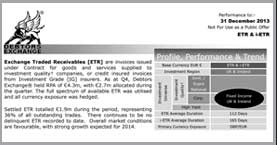
Exchange Traded Receivables [ETR], are invoices issued under Contract for goods and services supplied to investment quality† companies, or credit insured invoices from Investment Grade [IG] insurers. As at Q4, Credebt Exchange® held RPA of €4.3m, with €2.7m allocated during the quarter. The full spectrum of available ETR was utilised and all currency exposure was hedged.

Settled ETR totalled €1.9m during the period, representing 36% of all outstanding trades. There continues to be no delinquent ETR recorded to date. Overall market conditions are favourable, with strong growth expected for 2014.

Performance

2013-Q4 was the second quarter of trading for Credebt Exchange®. Total Debtors numbered 270+ with a total trade value of € 4.8m to date. Daily volume remained steady in excess of 1,300+. Highest single value trades were in October & December at an average of € 0.15m. Total current RSA are valued at € 15.1m+

Trend

Yield trend stabilised at an average of 3.75% during the quarter. Originator trading volumes continued on a slightly upward trend, with Investor demand slowing in December. Originator demand for 2014 will be strong. Additional capacity for RPA contracts of €10-15.0m are expected in Q1-2014, subject to Institutional Investor demand.

2013-Q4 ETR Briefing Trade Credebt

2013-Q4 ETR Briefing

† Investment quality is a combination of Investment Grade [IG] organisations & other credit worthy organisations, as determined by AIG and other credit rating providers, from time to time

More Posts Like This

How to use risk to your advantage

As explained in the previous article “It’s all about Risk…” you’ll now understand that larger organisations get preferential treatment from banks.  That’s the status quo and isn’t likely to change any time soon.  So what can you do to improve the banks perception of your business, so that you achieve ‘next best’ status?

The answer is to make sure you present your business as the ‘next best’ lowest possible risk.  This means you have to remove all possible negative ‘what if’ scenarios, wherever you can. What if these top two customers cancel their business with you? What if your cost of supplies increases unexpectedly?  What if a senior member of staff leaves? What if demand in your market declines suddenly?  And so on…

The more you think about all the risks that undermines the integrity and viability of your business, then you’re thinking like a banker.  Banks don’t like risk.  If you have given sufficient thought to the removal or reaction to risk, then you’re making it easier for them to lend to you.

More Posts Like This

It’s all about Risk

Once you understand risk, then you’ll begin to understand banks and how banking works.  Banks, investors, shareholders, managers, financial markets, brokers and other investment/lending professionals all learn about risk.  That’s not to say they necessarily understand risk in all its guises, but they must understand the principal that high risk is bad risk.

Think of it like parenting. Does a responsible parent leave a young child with the wild teenager next door, or do they leave the child with a mature, responsible adult? If you were a bank, who would you rather lend money to: an established, well managed, large company or the young start-up business (notice how inverting this speaks volumes: ‘up-start’)?

As a bank manager, if you are paid the same salary for lending to large companies as you were for lending to the up-starts (sorry, start-up), but were only promoted when the loan was repaid, who would you lend too?

Unless you’re being obstinate, the answer’s simple: the established, well managed, large company is less risky than the young start-up.  So they get the money first (and in most cases, at much lower cost too). Only after the large corporates market is satisfied, will banks look to the micro-medium sized, more risky market.

Low risk, high volume lending is more efficient and ‘safer’ than almost every type of other riskier lending to the micro-medium sized business.  That’s a simple fact of banking and isn’t likely to change any time soon.  So don’t get angry with your bank, if you were in their shoes, you’d probably use the same principal: low risk


More Posts Like This

Welcome to Credebt Exchange Blog

Credebt Exchange® enables service and goods providers to offer their invoices as Exchange Traded Receivables [ETR] for sale on the Exchange. These ETR are attractive to Investors and when purchased on the Exchange, this provides Alternative Working Capital to the Originator/seller. A key objective for Credebt Exchange® is to achieve rates that are comparable to, and preferably less than, other commercial finance lending rates. By selling ETR, the trading organisation is avoiding the need for loans and/or credit facilities by using the ETR to provide Alternative Working Capital

More Posts Like This

50+ Retail Investors

Today the Exchange received funds from it’s fiftieth Retail Investor.  Since the first date of trading on 4 July of his Year (see article: First RSA/RPA Trade Executed), achieving 50 Retail Investors demonstrates a strong appetite amongst the investment community for strong, short term cash-equivalents such as ETR….

More Posts Like This

2013-Q3 ETR Briefing

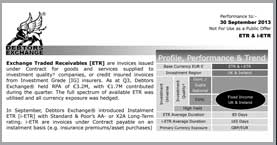
Exchange Traded Receivables [ETR] are invoices issued under Contract for goods and services supplied to investment quality† companies, or credit insured invoices from Investment Grade [IG] insurers. As at Q3, Credebt Exchange® held RPA of €3.2m, with €1.7m contributed during the quarter. The full spectrum of available ETR was utilised and all currency exposure was hedged

In September, Credebt Exchange® introduced Instalment ETR [i-ETR] with Standard & Poor’s AA- or X2A Long-Term rating. i-ETR are invoices under Contract payable on an instalment basis (e.g. insurance premiums/asset purchases)

Performance

2013-Q3 was the first quarter of trading for Credebt Exchange®. Debtor numbers to the end of September were circa 200. Daily volume rose sharply with total recorded trades in excess of 1,300+. Highest single value trades were in July and September at an average of € 0.4m. Current RSA valued at € 13.1m+

Trend

Yield continued to trend downwards during the quarter, reflective of prevailing deposit rates. Volume of Originator trading continued a steady trend upwards with Investor demand slowing in August and returning to steady growth in September. Outlook for Q4 is medium to strong with immediate, additional capacity for RPA contracts of €3-5.0m

2013-Q3 ETR Briefing Trade Credebt

2013-Q3 ETR Briefing

† Investment quality is a combination of Investment Grade [IG] organisations & other credit worthy organisations, as determined by AIG and other credit rating providers, from time to time

More Posts Like This

Unaffected by Seasonality

The Summer months tend to be the slowest for most Originators (and indeed Investors), however, August continues the steady growth experienced in Q2. The performance demonstrates that the initial Members of …

More Posts Like This

First RSA/RPA Trade Executed

Volume trading in Exchange Traded Receivables [ETR], has been strong using Revolving Sales Agreement [RSA] block and buy-out trades to increase market penetration. Little, or no, initial resistance in the market. Deals are delivering on Investor Revolving Purchase Agreement [RPA] …

More Posts Like This

Membership, Fees & Charges

IMPORTANT:- Some links in this article will only be accessible to authorised Members that have logged into the Exchange Trade Centre

Credebt Exchange® aims to be clear and transparent on the how it deducts charges (i.e. fees and commissions) from payments to any Member account. Before examining any deductions from a Member account, the Originator should log in to their account and view the Important Information items listed on the Exchange Trade Centre |
Dash Board (access to the Exchange Trade Centre is restricted to Members only) The information provided here is required reading.

There is also additional information in all of the articles in the Credebt Exchange® Tips & Help public section of this web site.   If any aspect of what is documented is not clear, Originators are invited to submit questions to Support using the Support & Customer Care Form.  Questions submitted using this form are regularly added to the Frequently Asked Questions, or FAQ, section of this web site.

Combining the Frequently Asked Questions, the articles contained in this section, the Credebt Exchange® Tips & Help and the Exchange Trade Centre | Dash Board with the documentation sent to all Originator Members, should provide a comprehensive understanding of the service.  Originators and all Members are encouraged to communicate their views to the Customer Care Team.

The most efficient way to communicate with Credebt Exchange® is by using the Support & Customer Care Form.  All submissions are responded to within 24-72 hours.

More Posts Like This